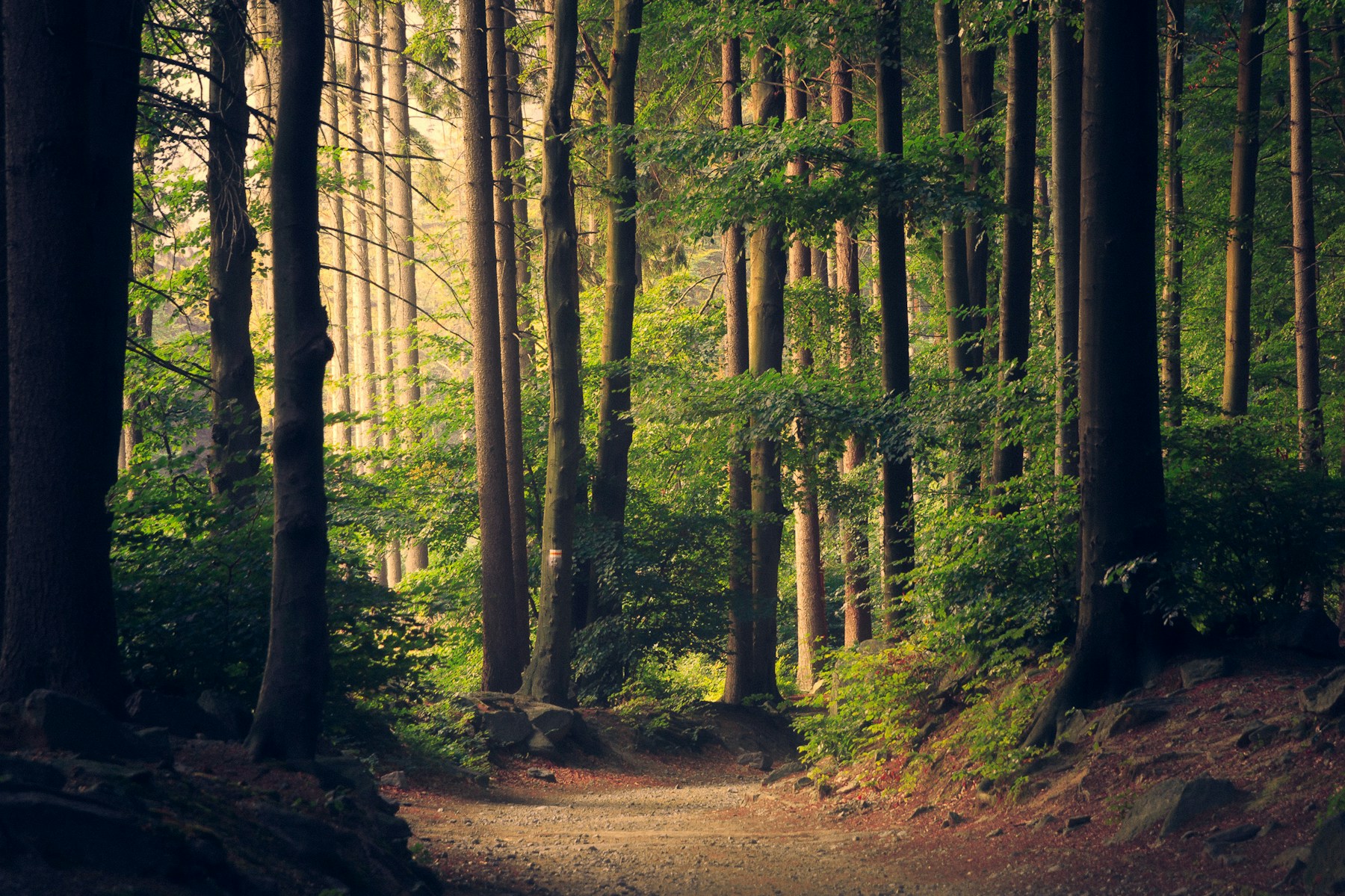
A forest is one of the easiest places to stand and one of the hardest places to photograph. The eye moves effortlessly between black bark, luminous leaves, and fragments of sky. A camera sees a much narrower range and often turns that richness into flat green noise.
Start by deciding what the light is doing. If it is soft and overcast, expose for the midtones and look for layers: a dark foreground, a readable middle distance, and one brighter surface deeper in the frame. In hard sun, meter for the highlights and let some shadows close completely. Trying to rescue every detail usually removes the atmosphere.
Expose for the light you want to keep, not every detail the sensor can recover.
A polarizing filter can reduce glare on wet leaves, but rotate it gently. Maximum polarization often makes foliage look unnaturally dense. A quarter-turn is usually enough to recover color while preserving the sheen that tells us the forest is wet.
Composition is mostly subtraction. Move until trunks stop merging, keep bright patches away from the corners, and decide which single detail is asking the viewer to enter the picture. The best setting is rarely the cleverest one. It is the one that lets the light remain the subject.
← Back to the journal1 answers