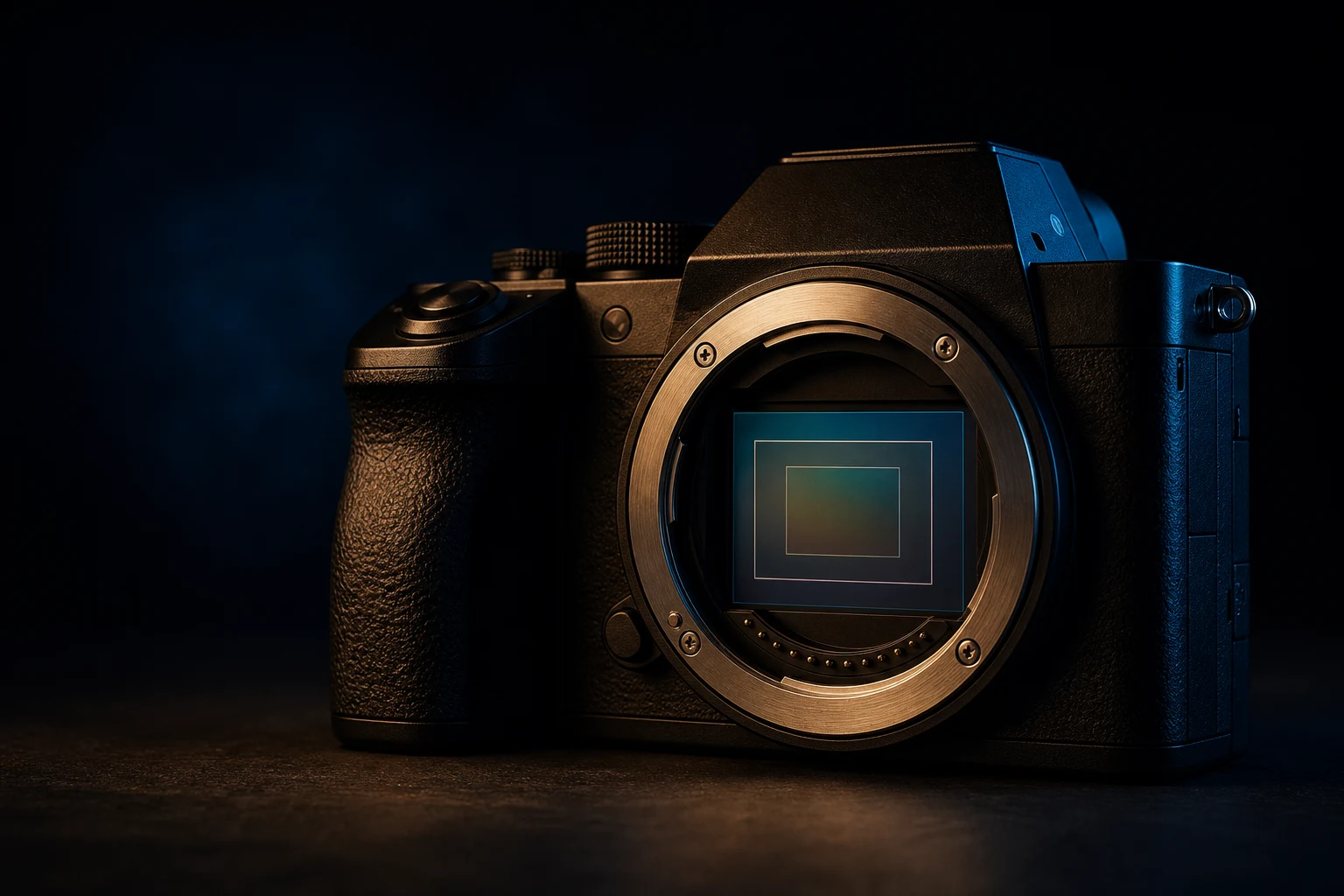
Sensor size changes the room a photographer has to work, not the merit of the photograph. A larger format generally leaves more room for shallow depth of field and clean results when light and shutter speed are constrained. A smaller format can turn unused margin into a shorter lens or a more manageable kit.
Neither tendency tells you which camera to buy. That choice depends on the frame you want, the light available, the movement in front of you, the finished output, and every lens you will carry. The important question is not simply which sensor is larger. It is what must stay the same in the comparison.
Sensor formats are different windows onto the same image
With the lens and camera position fixed, a smaller sensor records a smaller central part of the image projected by the lens. It does not lengthen the lens or alter perspective.
The usual reference is a 36 × 24 mm full-frame sensor. APS-C is not one exact size: common versions are approximately 23.5 × 15.6 mm, while Canon has also used about 22.3 × 14.9 mm. Micro Four Thirds is typically 17.3 × 13.0 mm. These dimensions produce the familiar approximate crop factors of 1.5×, 1.6×, and 2× when their diagonals are compared with the 35 mm still-photo frame, following CIPA's digital-camera specification guideline.
Crop factor is a useful shorthand, but not a perfect description of every edge. Full frame and most APS-C cameras normally use a 3:2 frame, while Micro Four Thirds uses 4:3. A 2× diagonal comparison therefore does not mean that both the horizontal and vertical dimensions differ by exactly two.
Smaller Type 1 sensors and larger digital medium-format sensors extend the scale in either direction, but the same comparison rules apply.
Decide what stays the same
Many sensor arguments sound contradictory because they compare different photographs. “The focal length changes,” “the exposure stays the same,” and “full frame gathers more light” are often attempts to describe different controlled variables—sometimes with careless language.
This table is a practical way to test any format claim:
| Hold constant | What changes | What the comparison reveals |
|---|---|---|
| Lens and camera position | Sensor boundary | Crop and field of view; focal length and perspective stay unchanged |
| Position and framing | Focal length | Depth of field and total-light differences at the same marked f-number |
| Position, framing, shutter time, and depth of field | Focal length and f-number | Approximate equivalence in pupil diameter, total light, motion blur, and output-level diffraction |
| Finished output | Files are resized to the same dimensions | A reader-visible result rather than unequal 100% pixel views |
This is a comparison method, not a promise that two files will be identical. Real lenses differ in transmission, aberrations, and rendering. Real sensors differ in efficiency, noise, processing, and calibration.
Crop factor changes the frame, not the focal length
A 50 mm lens remains a 50 mm lens on every format. On a 1.5× APS-C camera, it records roughly the angle of view that a 75 mm lens would record on full frame. On Micro Four Thirds, it frames roughly like a 100 mm full-frame lens. These are equivalent angles of view, not transformed focal lengths.
Perspective follows camera position. If you step backward to recover a wider composition after moving the lens to a smaller format, the perspective changes because you moved—not because the sensor altered the optics.
This distinction also exposes the weakness in the phrase “crop sensors give more reach.” A crop always provides a narrower ready-made frame. It gives more pixels on a distant subject only when the smaller-format camera has greater pixel density than the full-frame file being compared.
The arithmetic is simple. If the aspect ratio and pixel density are held constant, a crop retains roughly the full-frame megapixel count divided by the crop factor squared. A 24 MP full-frame file leaves about 10.7 MP after a 1.5× crop and 6 MP after a 2× crop. Sony documents the same geometry in a real camera: the a7R IV records approximately 60 MP across its full frame and about 26 MP in its APS-C crop mode (Sony specifications).
A dedicated 26 MP APS-C camera could therefore put about as many samples across the same framed subject as that particular full-frame crop. Another pairing could reverse the result. Even then, more samples become more visible detail only if the lens, focus, shutter speed, atmosphere, and processing preserve enough contrast.
The focused Answer Does a crop sensor give a lens more reach? carries this calculation into a compact field decision. The short version is that crop factor guarantees framing, not detail.
A larger sensor expands the exposure envelope
At the same scene luminance, shutter speed, f-number, and calibrated ISO, cameras of different formats should aim for similar image brightness. A larger sensor does not simply make the photograph brighter.
It does, however, collect light over a larger area. When the framing, shutter speed, and marked f-number are matched, that larger active area receives more total light for the whole image. Under comparable technology and at the same finished output size, more total photons generally leave more room for a cleaner result. That is a tendency, not a ranking: quantum efficiency, read noise, color filters, lens transmission, exposure, and processing all influence what a real camera records. The EMVA 1288 measurement standard is useful here precisely because it treats signal-to-noise ratio and dynamic range as products of several measured properties, not sensor dimensions alone.
The larger-format margin matters most when the subject demands a short shutter speed and the lens is already at its widest useful aperture. Think of a moving person in dim light, where adding exposure time would add motion blur. In abundant light, with a tripod, or when the photograph needs generous depth of field, that extra envelope may go unused.
Depth of field follows the opening in the lens
Sensor size does not blur a background by itself. At matched framing from the same position, the smaller format needs a shorter focal length. At the same f-number, that shorter lens has a smaller entrance pupil—the apparent aperture diameter seen through the front of the lens—and therefore produces greater depth of field.
The entrance pupil is focal length divided by f-number. This gives one useful calculation, not a field test: 50 mm at f/2.8 on full frame, about 33 mm at f/1.9 on 1.5× APS-C, and 25 mm at f/1.4 on Micro Four Thirds each have an entrance pupil close to 17.9 mm. From the same position, they should produce similar framing and approximate geometric depth of field, assuming ordinary subject distances. The relationship follows the standard f-number definition in Edmund Optics' aperture reference and the depth-of-field treatment in ZEISS's technical paper on depth of field and bokeh.
The 25 mm lens remains an f/1.4 lens for exposure. Calling it “50 mm f/2.8 equivalent” describes a particular cross-format comparison of angle of view, depth of field, total-light opportunity, and diffraction at a common output. It does not change the setting used by the meter.
This is where the larger format's advantage becomes concrete. If a smaller-format system offers the proportionally lower f-number you need, the two systems' envelopes can overlap. If it does not, the larger format retains access to shallower depth of field and more total light at the same shutter speed. The reverse is equally practical: deeper depth of field at a given marked aperture can be welcome for travel, landscape, documentary, and close-up work.
Equivalent depth of field is not identical bokeh. Lens design, aperture shape, aberrations, focus distance, and background distance still shape the character of blur. At high macro magnifications, nominal f-number and ordinary-distance equivalence also need more careful treatment.
Resolution and diffraction end at the finished photograph
Megapixels measure samples, not guaranteed scene detail. The useful chain begins with the subject and passes through atmosphere, motion, focus, lens contrast, sensor sampling, processing, and final output. A high-density sensor can preserve more information only while every earlier link carries that information forward.
Diffraction belongs in the same chain. Stopping down spreads fine detail gradually; there is no universal f/8 or f/11 cliff at which a format becomes unusable. At the same marked f-number, the ideal diffraction blur has the same physical diameter at the sensor plane, but the smaller capture needs more enlargement for the same print or display. When focal length and f-number are both scaled for equivalent framing and depth of field, the smaller sensor-plane blur is enlarged proportionally, so the output-level trade is also approximately matched. Edmund Optics' guide to the Airy disk explains the physical relationship; Cambridge in Colour's diffraction tutorial places it in the context of sensor sampling and finished output.
Judge the aperture by the depth of field the photograph needs and the output it must survive, not by a format slogan.
Smaller kits are real when the compromise is useful
A smaller sensor does not guarantee a smaller camera body. Controls, battery, viewfinder, stabilization, cooling, construction, and weather protection all occupy space regardless of format. Bodies from different systems can overlap substantially in mass and dimensions.
Lenses are where the trade can become more pronounced. A shorter telephoto can match a long full-frame lens's angle of view while accepting a smaller entrance pupil. That can make the lens easier to carry, but it does not match the larger lens's shallow-depth-of-field and total-light envelope at the same shutter speed. In daylight, or when deeper depth of field helps keep an unpredictable subject sharp, that may be an excellent bargain rather than a defect.
If the smaller-format lens is made fast enough to restore equivalent depth of field and total light, its entrance pupil grows toward the same diameter as the larger-format lens. Some of the size advantage then disappears. Physical lens size still depends on image circle, optical corrections, focusing groups, zoom design, materials, sealing, and stabilization, so pupil diameter is a decision aid rather than a weight calculator.
Shop complete systems rather than sensor labels. Compare the field of view, usable aperture envelope, close-focus needs, body, every lens, batteries, and any support you will actually take. It helps to set the size you will actually carry before comparing bodies on a specification page.
Choose by the constraint in your photographs
Portraits and low-light events. A larger format earns its burden most clearly when you need a fast shutter and shallow depth of field at the same time, and the lens is already wide open. Compare available lenses and controlled performance measurements for the actual cameras; the format name cannot settle the purchase.
Travel and everyday photography. When extreme blur or low-light margin is not the constraint, a smaller lens set can matter more than theoretical headroom. Define the focal range and maximum carried mass first. A compact full-frame body with a modest lens may still undercut a feature-rich smaller-format setup, so weigh the real bag.
Wildlife and field sport. Identify the failure before prescribing a format. Is the problem framing, too few pixels on the subject, shutter-speed noise, autofocus, or the physical burden of the lens? A smaller format can deliver the desired angle of view with a shorter, smaller-pupil lens. A high-resolution full-frame camera may retain similar sampling after a crop while keeping the wider uncropped frame. Neither follows from crop factor alone.
Landscape, close-up work, and large prints. For static subjects, tripod use, stitching, focus stacking, technique, and final output can outweigh a simple sensor hierarchy. Greater depth of field at a marked f-number may help. Heavy crops and large prints depend on actual resolution, lens contrast, technique, processing, viewing distance, and the finished size—not merely the format printed on the camera.
What sensor size cannot tell you
Sensor size does not determine autofocus, sensor readout and rolling shutter, burst depth, viewfinder quality, controls, stabilization, weather sealing, color processing, lens quality, service, or whether you enjoy using the camera. Format can influence an engineering constraint, but it cannot replace evidence about a particular implementation.
Video modes require their own check. A stills camera may crop, bin, subsample, or read a different part of the sensor for different recording modes, so its still-photo format alone does not predict its motion performance.
Start a purchase with the photographs. Name the framing, shutter speed, and depth of field they require; decide how large the result must be; then price and weigh the complete bodies and lenses capable of meeting that contract. If two formats satisfy it, choose the one that removes more friction from carrying and using the camera. Sensor size matters most near the edge of its envelope. Away from that edge, the photograph receives no award for the rectangle behind the lens.
Selected references
- CIPA DCG-X002-2015: Specification Guideline for Digital Cameras
- EMVA Standard 1288, Release 4.0
- Edmund Optics: Imaging System Parameter Calculator
- ZEISS: Depth of Field and Bokeh
- DPReview: What is equivalence and why should I care?
- Sony: a7R IV specifications
- Cambridge in Colour: Diffraction Limited Photography